

- What is overthinking, and when is thinking actually helpful?
- Is this thinking helping me, or just changing how I feel?
- Is overthinking a mental health diagnosis?
- Research and guidance
Before you read further, think of a decision you have recently found difficult to leave alone. Perhaps you were choosing how/what to say in a text, deciding whether to apply for a new job role, or wondering whether you had upset someone.
What were you hoping to achieve by thinking about it a little longer?
You might say: “I needed to make the right choice”, “I want to understand what happened”, or “It feels less likley to make mistakes”. All are reasonable answers as thinking helps us prepare, learn and making decisions. The challenge is to recognise when thinking has stopped helping and begun taking us around the same questions again. For me, this is a useful sign that thinking may be shifting from helping us to solve a problem to keeping us caught in worry.
If you are looking for how to stop overthinking, a possibly useful starting point is to notice that shift. Identify what you can act on, take a proportionate next step, and practise leaving the remaining uncertainty unresolved.

What is overthinking, and when is thinking actually helpful?
Imagine you are writing an email to a colleague to ask for an update. You check their name, make sure your question is clear, and correct a spelling mistake. So far, the thinking has served a purpose.
Then another question appears: “Do I sound impatient?”
You change a sentence and read it again. The new version seems better, although perhaps you feel that it now sounds too apologetic, so you change it back. And just like that, you are now considering how this colleague has responded to you in the past and whether asking for an update was OK at all.
The email is still only three sentences long. You have now spent more than ten minutes on it.
“Overthinking” is an everyday term rather than a diagnosis. Researchers study related patterns such as worry, rumination, post event processing (and more) under the broader concept of persistent or repetitive negative thinking; (Ehring & Watkins, 2008: Moulds & McEvoy, 2025). These patterns can occur across the population, with and without mental-health difficulties Repeated thought is not necessarily a problem. Reflecting on something important can be useful even when it is uncomfortable and takes time. Research distinguishes between constructive and unconstructive repetitive thinking, with its context and the way we think making a difference (Watkins, 2008).
A useful question, therefore, is: “What is this next round of thinking adding?”
You may be discovering something, considering a different perspective or working towards a decision. Or you may be revisiting the same possibilities because none of the answers feels certain enough.

Is this thinking helping me, or just changing how I feel?
Let us look at the email from two different perspectives: “Is this thinking helping me make progress?” and “How does it leave me feeling right now?” Feeling better and making progress are different outcomes. An uncomfortable conversation may be a useful next step; remembering a kind comment may offer comfort without resolving the task.
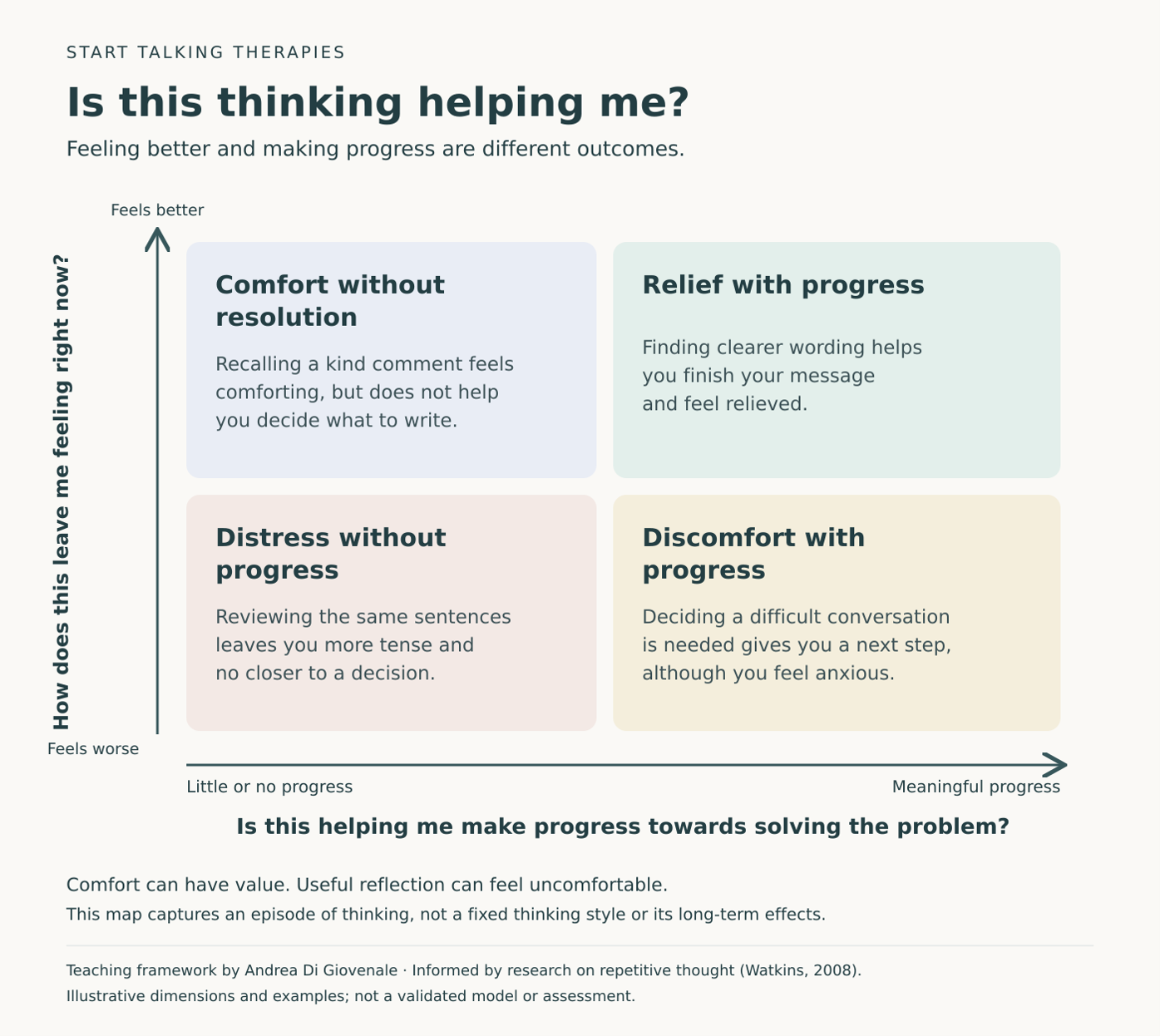
A reflection tool developed by Andrea Di Giovenale, informed by research on repetitive thinking. These two dimensions are proposed for teaching purposes and have not been validated as an assessment. The diagram captures immediate feelings and practical progress; it does not measure every emotional benefit or longer-term consequence.
Is overthinking a mental health diagnosis?
No. Overthinking is an everyday description. Persistent repetitive thinking can occur with different difficulties, and assessment helps clarify the wider picture.
Is this thinking helping me, or just changing how I feel?
Feeling better and making progress are different outcomes. Thinking can feel uncomfortable while helping you move forward, and comforting thoughts can have value even when they do not solve a problem.
Think back to the decision you chose at the beginning. What would a reasonable next step look like if you did not have to feel completely in control or certain first?
Disclaimer: This article provides general educational information and is not intended as individual psychological advice, assessment, diagnosis, or treatment. Reading this content does not establish a therapist–client relationship.
Reference and guidance
Ehring, T., & Watkins, E. R. (2008). Repetitive Negative Thinking as a Transdiagnostic Process. International Journal of Cognitive Therapy, 1, 192-205.
Moulds, M. L., & McEvoy, P. M. (2025). Repetitive negative thinking as a transdiagnostic cognitive process. Nature Reviews Psychology, 4, 127–141. Read source
Watkins, E. R. (2008). Constructive and unconstructive repetitive thought. Psychological Bulletin, 134(2), 163–206.
If you would like support with anxiety patterns, you can contact me throgh the form to arrange a free 15-minute introductory conversation to discuss whether working together could help.
About the author
Andrea Di Giovenale is a BABCP-accredited CBT therapist and EMDR therapist at Start Talking Therapies. He works with adults experiencing persistent anxiety, worry and self-doubt, as well as those affected by trauma, including childhood emotional neglect. He helps people understand their patterns and practise responding differently, offering online therapy with flexible appointment times, including early mornings and late evenings.